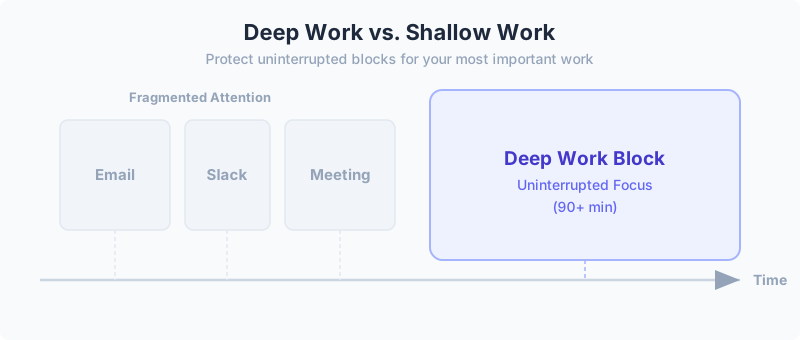
Cal Newport's Deep Work makes a compelling case: the ability to focus without distraction on cognitively demanding tasks is becoming both increasingly rare and increasingly valuable. People who cultivate this ability will thrive. People who don't will be left behind.
The book is full of inspiring examples, Carl Jung building a stone tower to write in isolation, J.K. Rowling finishing the last Harry Potter book in a hotel suite, but most readers finish the book and immediately get interrupted by a Slack notification.
The problem isn't that we don't value deep work. It's that we don't have a concrete protocol for protecting it.
Workers are interrupted every 2 minutes, roughly 275 times per day. Each interruption costs 23 minutes to regain full focus (Gloria Mark, UC Irvine). The average knowledge worker gets only 2 hours and 53 minutes of actual productive work per day.
A Deep Work Protocol You Can Start Tomorrow
Here is a step-by-step recipe. Try it for one week before changing anything.
1. Choose tomorrow's deep work task tonight. Before you leave your desk (or during an evening review), pick the single most important cognitively demanding task for tomorrow. Write it down somewhere you'll see it first thing. Deciding tonight means you don't waste morning willpower on choosing.
2. Block 90 minutes on your calendar. Treat it like a meeting with your most important client. If someone tries to schedule over it, decline. If 90 minutes feels impossible, start with 50 and work up.
3. Before the block: close everything. Close email. Close Slack. Silence your phone and put it in another room (not face-down on your desk, in another room). Set a timer for the duration. If you work in an open office, put on headphones even if you're not listening to anything.
4. Work on ONLY the chosen task. If a thought about something else pops up ("I need to email Sarah," "I forgot to buy milk"), write it on a scrap of paper and immediately return to the task. Don't open your inbox to "quickly" send the email. The scrap paper captures the thought so your brain can let go of it.
5. When the timer ends, take a real break. Stand up. Walk outside. Get water. Stretch. Do not pick up your phone and scroll. The break needs to be genuinely restful, not a different kind of stimulation. Even 10 minutes of actual rest recharges focus for the next block.
6. Log the session. Write down what you worked on, how long you actually focused, and whether you completed what you intended. This takes 30 seconds and creates accountability. Over time, you'll see patterns: which days are best for deep work, which tasks take longer than expected, and how much focused time you actually get in a week (the number is usually sobering).
Why This Works: Attention Residue
Newport cites research on "attention residue," the phenomenon where thinking about one task reduces your performance on the next. Every time you switch contexts, a residue of the previous task lingers in your mind, fragmenting your focus. Checking email "for just a second" during a deep work block doesn't cost you one second; it costs you 10-15 minutes of degraded attention. The numbers back this up: context switching consumes up to 40% of productive time, and the average worker spends 60% of their day on "work about work" (status updates, searching for information, and coordinating tools) rather than the deep thinking that actually moves projects forward.
The protocol above works because it eliminates the sources of attention residue: undecided tasks (you chose last night), notification interruptions (everything is closed), and context-switch temptation (the scrap-paper capture keeps stray thoughts from pulling you out of flow).
The Shutdown Ritual
Newport recommends a "shutdown ritual" at the end of each workday, a routine that closes all open loops and gives your mind permission to fully disengage. Without it, work thoughts bleed into your evening and you never truly rest.
A good shutdown ritual takes 10-15 minutes:
- Process your inbox (email, task inbox, notes from the day)
- Review your calendar for tomorrow
- Choose tomorrow's deep work task (step 1 of the protocol above)
- Say "shutdown complete" (Newport literally recommends a verbal cue)
The key insight: the ritual isn't about finishing everything. It's about confirming that everything has a place in a system you trust, so your brain stops running background processes on unresolved tasks. David Allen calls these "open loops," commitments you've made but haven't organized. Each one consumes a sliver of mental bandwidth. The shutdown ritual closes them.
The Deep Work Equation
Newport's formula is simple:
High-Quality Work Produced = (Time Spent) x (Intensity of Focus)
You can't just spend more time. You need focused time. And focus requires eliminating the cognitive clutter that pulls your attention away. This means two things:
- During deep work: follow the protocol. No email, no phone, no exceptions.
- Outside deep work: maintain a trusted system so open loops don't gnaw at your focus. Capture tasks, process your inbox, and review your commitments regularly.
Making Deep Work a Habit
Newport says deep work should be treated as a habit, not a special occasion. It needs to be scheduled, protected, and repeated until it becomes automatic.
Start by tracking it. Set a daily target, even a modest one: "25 minutes of deep work." Log each session (step 6 of the protocol). Track your streak. Most people are shocked to discover they get less than an hour of genuinely focused work per day, even when they feel busy for eight hours.
Gradually increase the duration. Once 50-minute blocks feel natural, try 90 minutes. Newport reports that even elite practitioners rarely sustain more than four hours of deep work per day. The goal isn't to fill every hour with intense focus; it's to make the hours you do spend count.
The irony of deep work is that the system around it needs to be shallow, simple, automatic, and low-effort. You need something that handles the logistics so you can spend your mental energy on the work that matters. Tools like Actium can help by organizing tasks by context, automating the capture-and-review cycle, and keeping open loops closed, but the protocol itself is tool-agnostic. A notebook and a timer are enough to start. In a world where the average worker is productive for less than 3 hours a day, protecting even one 90-minute block of deep work can double your meaningful output.
For the daily ritual that makes deep work sustainable, see The Power of a Daily Review. To understand the value of separating planning from execution, read Delegate the Planning, Approve the Plan.