Open your to-do list right now. How many items are on it? If you're like most people, the answer is somewhere between "too many" and "I stopped counting." Twenty tasks. Thirty. Maybe more. You look at it and feel a familiar wave of anxiety, not because the tasks are particularly hard, but because there are so many of them that you don't know where to start.
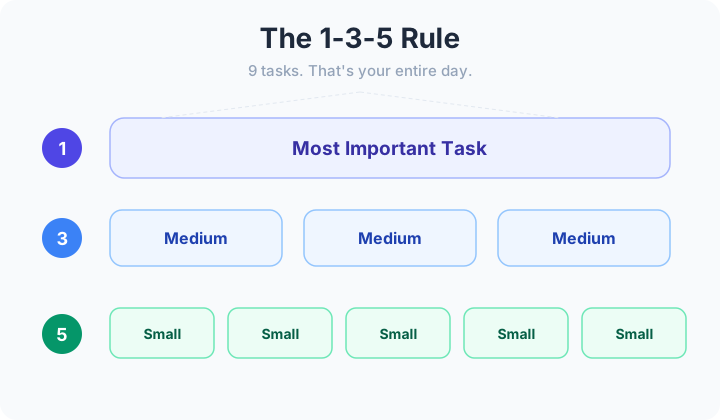
The 1-3-5 Rule is a daily planning method that solves this problem with brutal simplicity: every day, you plan to accomplish 1 big task, 3 medium tasks, and 5 small tasks. That's 9 items total. No more.
41% of to-do list items are never completed (iDoneThis). Only 11% of professionals finish everything on their daily list. The problem isn't discipline; it's that most lists are designed to grow, not to be finished.
Why 1-3-5 Works
It forces prioritization
When you can only pick 9 tasks, you have to choose. That act of choosing, deciding what makes the cut and what doesn't, is the real work of productivity. Most people skip this step entirely. They dump everything onto a list and hope for the best. The 1-3-5 Rule makes prioritization unavoidable.
It creates realistic expectations
Research consistently shows that people overestimate what they can accomplish in a day and underestimate what they can accomplish in a year. The 1-3-5 Rule provides a corrective: 9 tasks is roughly what a focused person can actually complete in a standard workday. By capping your daily plan at 9, you stop setting yourself up for failure.
The data confirms this: 85% of completed tasks were unplanned. They were never on any to-do list. That means most of your real work happens outside your list anyway. The 1-3-5 Rule embraces this reality by giving you a short, achievable plan that leaves room for life.
It gives you a finish line
An infinite to-do list has no endpoint. You never feel "done" because there's always more. A 1-3-5 list has a clear finish line: when you've completed all 9 tasks, you're done for the day. That sense of completion is psychologically powerful. It lets you stop working without guilt.
It balances depth and breadth
The structure acknowledges that not all tasks are equal. You have one task that requires deep focus, three that require moderate effort, and five that are quick wins. This mix ensures you make progress on important work while still clearing the decks of smaller items.
How to Categorize Tasks by Size
The hardest part of the 1-3-5 Rule is deciding what's "big," "medium," or "small." Here's a practical framework:
Big tasks (1 per day)
A big task requires 60-90+ minutes of focused effort. It demands real cognitive engagement. It's usually the task you'd be most tempted to procrastinate on. Examples:
- Write the first draft of a report
- Prepare a presentation from scratch
- Have a difficult conversation with a team member
- Design a new process or workflow
- Complete a complex code review
You do one big task per day. If you have two big tasks, one of them is tomorrow's big task.
Medium tasks (3 per day)
A medium task takes 15-45 minutes. It requires attention but not deep focus. Examples:
- Review and respond to a detailed email thread
- Update a project plan or status report
- Attend a meeting and write up action items
- Research a vendor or tool option
- Edit a document someone sent for review
Small tasks (5 per day)
A small task takes under 15 minutes. These are your quick wins, the "clear the decks" items. Examples:
- Reply to a straightforward email
- Schedule a meeting
- Approve a request
- File an expense report
- Update a shared spreadsheet with one data point
If a task takes under two minutes, you might not even need to put it on the list. Just do it when it comes up (the 2-Minute Rule in action).
Set Up Your 1-3-5 List Tonight for Tomorrow
The best time to create your 1-3-5 list is the evening before. Here's a step-by-step:
Step 1: Brain dump. Write down everything you can think of that needs doing tomorrow. Don't filter. Just dump.
Step 2: Identify your 1 big thing. Scan the list and ask: "Which single task would make tomorrow feel successful if I completed it?" That's your big task. Circle it.
Step 3: Pick your 3 medium things. Look at what's left and choose three items that are important but not as demanding as the big task. Star them.
Step 4: Choose your 5 small things. From the remaining items, pick five quick tasks you can knock out between other work. Check them.
Step 5: Move everything else off the list. This is the hard part. Everything that didn't make the cut goes back to your master task list, your someday/maybe list, or next week's plan. It does not go on tomorrow's daily list. The whole point is that tomorrow has exactly 9 items.
Step 6: Order your day. Big task goes first (eat the frog). Medium tasks fill the spaces between meetings. Small tasks batch together in the late afternoon or between blocks.
What to Do When You Have More Than 9 Tasks
You will always have more than 9 tasks that could be done. That's not a bug. That's the reality of a full life. The question isn't "how do I fit everything in?" It's "what matters most today?"
Triage ruthlessly
Ask of each task: "What happens if this doesn't get done today?" If the honest answer is "nothing bad," it doesn't make today's list.
Defer intentionally
Move tasks to specific future dates. "This needs to happen, but not today" is a perfectly valid decision. Deferring isn't procrastinating; it's planning.
Use your someday/maybe list
Some tasks on your list aren't actually urgent or important. They're ideas that snuck onto your active list. Move them to someday/maybe, where they'll be reviewed during your weekly review but won't clutter your daily plan.
Accept incompleteness
You will never finish everything. No one does. The 1-3-5 Rule helps you accept this gracefully by giving you a clear definition of "enough" for each day. Nine tasks done well beats twenty tasks done poorly.
Variations and Adaptations
The 1-3-5 Rule is flexible. Adjust it to your reality:
- Heavy meeting days: Try 1-2-3 instead. If half your day is meetings, you simply have less capacity for tasks.
- Low-energy days: Drop to 0-2-5. Skip the big task, handle a couple of medium items, and clear small stuff. That's still a productive day.
- Deep work days: Try 1-1-3. One big task with extended focus time, one medium follow-up, and three quick items. Keep the decks clear for deep thinking.
The numbers aren't sacred. The principle is: cap your daily ambition at what's realistic, and force yourself to choose.
How Actium Helps With the 1-3-5 Approach
When you have a backlog of tasks across multiple projects and areas of focus, deciding which 9 to focus on today can feel like a project in itself. Actium' AI planning can help here: it analyzes your full backlog, considers priorities and deadlines, and can suggest a daily plan that naturally follows the 1-3-5 structure, one high-impact task, a few medium priorities, and a set of quick wins.
During your daily review, you can review the AI's suggestion, adjust it based on your energy and schedule, and walk into the day with a clear, bounded plan. No more staring at a list of forty items wondering where to start.
Start Tonight
Before you go to bed tonight, try the 1-3-5 exercise. Write down your 1 big task, 3 medium tasks, and 5 small tasks for tomorrow. Put the list where you'll see it first thing in the morning.
Tomorrow evening, check in: how many did you complete? If you got all 9, that's a great day. If you got 6 or 7, that's still a good day, and it tells you something useful about your capacity and estimation skills. Adjust and repeat.
Within a week, you'll have a much clearer picture of what a realistic day looks like for you. In a world where 41% of tasks are never completed and only 11% of people finish their daily list, the 1-3-5 Rule gives you something radical: a list you can actually finish.
For the method behind choosing your #1 big task, read Eat the Frog. To handle the tasks that don't make today's cut, see Someday/Maybe: The Most Underrated Productivity List. And for the daily ritual that powers your 1-3-5 planning, check out The Power of a Daily Review.