Three books have shaped how millions of people think about habits: BJ Fogg's Tiny Habits, James Clear's Atomic Habits, and Charles Duhigg's The Power of Habit. Each offers a different framework. But strip away the branding, and they converge on the same core truths.
91% of people fail to achieve their New Year's resolutions. Nearly 80% abandon them by January 19th. Over 40% of your daily actions are habits, not conscious decisions (Duke University). The science is clear: if you want to change your life, don't set goals. Build habits.
Understanding where these three authors agree is more useful than memorizing any single framework. Here's what they all got right.
The Habit Loop: How Every Habit Works
Duhigg's The Power of Habit gave us the foundational model: every habit follows a three-step loop.
Cue → Routine → Reward.
The Cue is the trigger: a time of day, a location, an emotion, an event. The Routine is the behavior itself. The Reward is the payoff that makes your brain remember the loop for next time.
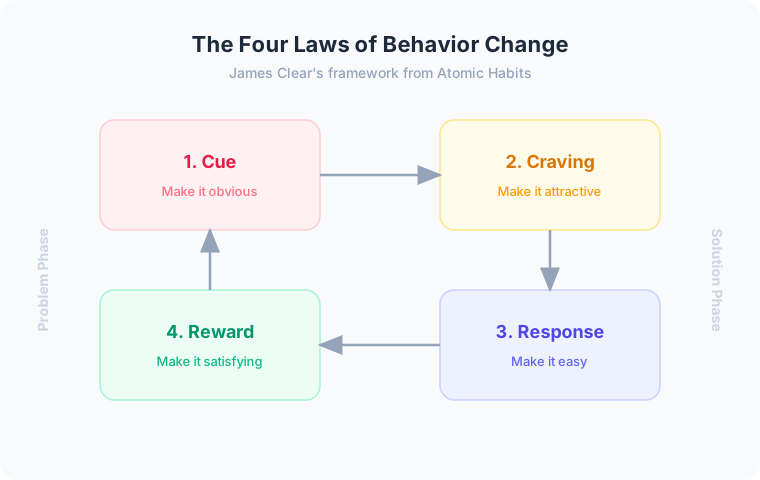
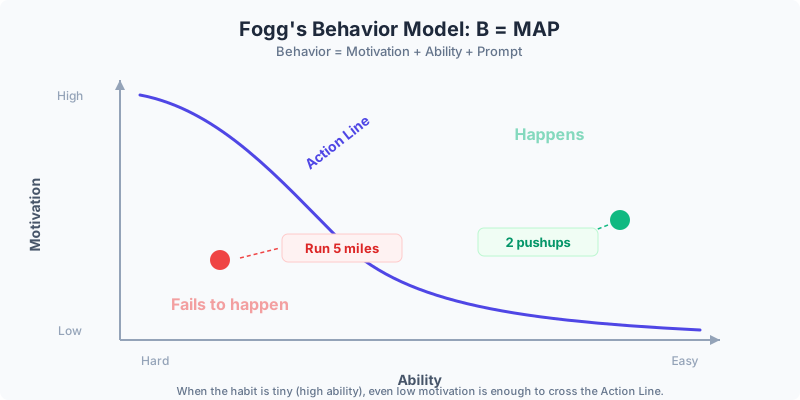
Fogg refined this with his B=MAP model: Behavior happens when Motivation, Ability, and a Prompt converge at the same moment. Clear organized it into Four Laws: make it obvious (cue), make it attractive (motivation), make it easy (ability), make it satisfying (reward).
Different vocabulary, same insight: habits aren't about willpower. They're about designing the right conditions.
Start Embarrassingly Small
This is the single most important point all three authors agree on.
Fogg calls it the "Tiny Behavior": two pushups, not twenty. He's coached over 40,000 people through the Tiny Habits method since 2011, and his research shows that without structured behavioral design, people are approximately 80% likely to fail at behavior change.
Clear calls it the "Two-Minute Rule": scale any habit down to something you can do in under two minutes. Don't "read for 30 minutes." Just "open the book."
Duhigg emphasizes reducing friction on the routine. The easier the behavior, the more likely the loop fires. One pushup still completes the cue-routine-reward cycle.
It takes a median of 66 days, not the mythical 21, for a behavior to become automatic (European Journal of Social Psychology). The range spans from 18 to 254 days. That's a long runway, and only habits small enough to survive your worst days will make it to the end.
Identity Over Goals
Clear's most powerful contribution is the concept of identity-based habits. You don't "try to read more"; you become "a person who reads every day." The behavior shift follows the identity shift.
Fogg arrives at the same place from a different angle: when you celebrate after each tiny habit ("I'm awesome!"), you're not just reinforcing the behavior; you're reinforcing the identity. After 30 days of two pushups, you're "someone who exercises daily." The quantity doesn't matter. The consistency does.
Duhigg frames it through keystone habits: a single habit that triggers a cascade of other positive changes. People who start exercising regularly also tend to eat better, sleep more, and spend less impulsively. The keystone habit reshapes identity, and identity reshapes everything downstream.
Systems Beat Goals
Clear's most provocative claim: "You do not rise to the level of your goals. You fall to the level of your systems."
All three authors agree that the gap between understanding habits and actually building them is where most people get stuck. Knowing the loop exists (Duhigg), knowing to start small (Fogg), knowing the four laws (Clear), none of it matters without a system that maintains the habit day after day.
This is where most self-help books leave you stranded. You finish the book inspired, try the technique for a week, and quietly abandon it. The problem isn't the science; it's the lack of infrastructure.
The Valley of Disappointment
Clear warns about the "Valley of Disappointment," the period where you're putting in the work but haven't seen results yet. This is where most people quit.
The math is striking: 1% better every day for a year makes you 37 times better. But the growth curve looks flat for months before it explodes upward. That flat period is the Valley of Disappointment, and it's where most people quit because they can't see the compounding yet.
Research confirms it: people who set small, measurable approach-oriented goals succeed 22% more often than those who set avoidance-oriented goals (PLOS ONE). "Read one page a day" beats "stop wasting time," not because it's harder, but because it's designed to survive the valley.
Having a system that visibly tracks your consistency helps you survive this period. When the scale hasn't moved but you can see a 45-day streak, you have proof that you're on the right track.
The Golden Rule of Habit Change
Duhigg's "Golden Rule" deserves special attention: you can't extinguish a bad habit. You can only change the routine while keeping the same cue and reward. Crave a cookie every afternoon? Keep the cue (3pm slump) and the reward (break from work), but swap the routine (take a walk instead).
This means habit change isn't about stopping behaviors. It's about replacing them. Instead of "stop snacking," create a positive habit: "Afternoon walk." The system gives you something to do rather than something to resist.
The All-or-Nothing Trap
Most habit trackers are binary — you either did it or you didn't. That creates pressure on bad days and guilt when you miss. Research shows that 92% of habit tracking attempts fail within 60 days, and over 52% of users quit habit apps within 30 days. The culprit? All-or-nothing design. When "success" means hitting an ambitious daily target, one bad day breaks the streak, and a broken streak breaks the habit.
A better approach: the Minimum/Upgrade system. For every habit you want to build, you define two thresholds:
- The Minimum is the smallest version of the habit you can do on your absolute worst day. One pushup. One page. Two minutes of meditation.
- The Upgrade is what you aim for on a normal or great day. Twenty pushups. Thirty minutes of reading.
The key insight: hitting the Minimum counts as a full win. Your streak stays alive. On your best days, you'll naturally reach for the Upgrade. On tough days, the Minimum keeps you in the game. Over weeks and months, the consistency compounds into real results.
Research in habit formation consistently shows that frequency matters more than intensity. A person who does one pushup every single day for a year builds a stronger habit loop than someone who does intense workouts three times a week for two months before burning out. Tracking 7 or more habits simultaneously correlates with a 78% higher abandonment rate. Flexible consistency — showing up 80% of days at any intensity — is more sustainable than rigid streaks demanding 100% effort.
How Actium Applies All Three Frameworks
When we designed the habit system in Actium, we drew from all three authors:
Automated Cues (Duhigg + Clear's Law 1). The daily review is a reliable, daily cue that surfaces your habits front and center. You don't have to remember; the system puts them in front of you every morning.
The Minimum (Fogg + Clear's Law 3). When you create a habit, you set a Minimum — the absolute smallest version you can do on your worst day. One pushup. One page. Two minutes of meditation. The system counts hitting the Minimum as a complete success. Your streak stays alive.
Visible Rewards (Duhigg + Clear's Law 4). Your streak number goes up. Your weekly progress bar fills. Your area-level reports show improvement. These proxy rewards bridge the gap between doing the work and seeing the long-term results.
Keystone Integration (Duhigg). The daily review itself functions as a keystone habit: one five-minute ritual that keeps all your other habits alive.
Putting It Into Practice
If you've read any of these three books and loved the ideas but struggled to implement them, here's how to start:
- Pick one habit you want to build
- Set a Minimum so easy it's almost embarrassing (Fogg's tiny behavior, Clear's two-minute rule)
- Set an Upgrade that represents your ideal daily effort
- Anchor it to an existing routine (Fogg's recipe: "After I [existing habit], I will [tiny behavior]")
- Show up every day, even if you only hit the Minimum
- Review weekly. Let the system show you your progress
With 91% of resolutions failing and 40% of daily behavior running on autopilot, the stakes are high: design your habits deliberately, or live with the ones you stumbled into by accident. The science is settled. What most people lack isn't knowledge; it's a system that makes the science automatic.