The most enduring idea in personal productivity is deceptively simple: get everything out of your head and into a trusted external system, so your mind is free to focus on the task at hand rather than remembering what comes next.
This capture-first philosophy has been around for decades, and its core principles still hold. But the tools have changed. Paper inboxes have given way to digital capture. Manual weekly reviews can now be guided by AI. And the biggest weakness of any structured productivity system — the overhead of maintaining it — can finally be addressed.
The average knowledge worker spends 2.5 hours per day just searching for information and organizing tasks (McKinsey). A structured system reduces this overhead, but only if you maintain it. Most people don't, which is why the majority of productivity system adopters abandon their approach within six months.
The Five Steps
Every effective productivity system breaks down into five stages. Understanding each one is essential before you can modernize them.
1. Capture
Get everything off your mind. Every task, idea, commitment, and nagging thought goes into an inbox. The goal is total capture — if it's on your mind, it belongs in the system.
The original methods used physical inboxes, notebooks, and voice recorders. Today, the capture surface is much larger: text messages, emails, Slack threads, voice notes, photos of whiteboards. The challenge isn't capturing — it's capturing into one system instead of scattering thoughts across twelve apps.
The modern problem: we capture plenty, but into too many places. Notes in one app, tasks in another, reminders in a third. The system only works when everything funnels into a single inbox.
2. Clarify
For every item in your inbox, ask: What is this? Is it actionable?
If it's not actionable, it goes into one of three buckets: trash (delete it), reference (file it), or Someday/Maybe (park it for later). If it is actionable, define the very next physical action. Not "handle the report" — that's vague. The next action is "Open the Q3 spreadsheet and update the revenue row."
This step is where most people get stuck. Clarification requires cognitive effort, and when your inbox has 47 items, the temptation is to skim and procrastinate. This is precisely where AI can help most: an AI assistant can propose next actions, suggest projects, and tag context — all subject to your approval.
3. Organize
Put clarified items where they belong:
- Next Actions: things you can do right now, organized by context (at computer, on phone, errands, calls)
- Projects: any outcome requiring more than one action step
- Waiting For: things you've delegated or are waiting on someone else
- Calendar: time-specific commitments only (not aspirational task scheduling)
- Someday/Maybe: things you might want to do eventually but not now
- Reference: information you might need later
A strict taxonomy matters for a reason: when every item has a clear home, you can trust the system. When items are ambiguous, you stop trusting it, and when you stop trusting it, you stop using it.
4. Reflect
The weekly review is the engine that keeps a productivity system running. Without it, the system decays within days. A proper review means scanning every project, checking your calendar, processing your inbox to zero, and refreshing your next actions list.
The weekly review typically takes 30-60 minutes. It's the single most important habit in any structured system, and also the one most people skip. The overhead feels too high, especially on busy weeks — the exact weeks when you need the review most.
This is the Achilles heel of traditional systems. They require regular human maintenance. Skip the review for two weeks and your lists become stale, your inbox overflows, and you lose trust in the system. That's why the abandonment rate is so high.
5. Engage
With a clean system, choosing what to work on becomes simple. Four criteria help you decide in the moment: context (where are you?), time available (how long do you have?), energy level (how alert are you?), and priority (what matters most?).
When your next actions are properly organized by context, the right tasks surface naturally. You don't need to scan your entire list — you look at the "at computer" list when you're at your computer, the "errands" list when you're out.
Where Traditional Systems Break Down
The five-step framework is brilliant in theory. In practice, three problems kill it for most people:
1. The maintenance tax. Processing every inbox item, maintaining project lists, doing weekly reviews — this overhead is the system's biggest cost. For people with complex lives (multiple responsibilities, shifting priorities), the maintenance can feel like a second job.
2. No planning intelligence. The system tells you to define next actions, but it doesn't help you plan complex goals. "Run a marathon" becomes a project, but nothing tells you what the 36 training tasks should be or how to sequence them. You still need domain expertise to build the plan.
3. No accountability loop. Traditional productivity systems are solo endeavors. There's no mechanism for someone else to check if you're on track, no structured way to share responsibility, and no consequence for skipping a review. For many people, this means the system quietly dies the first busy week.
AI: The Missing Piece
Modern AI addresses all three weaknesses:
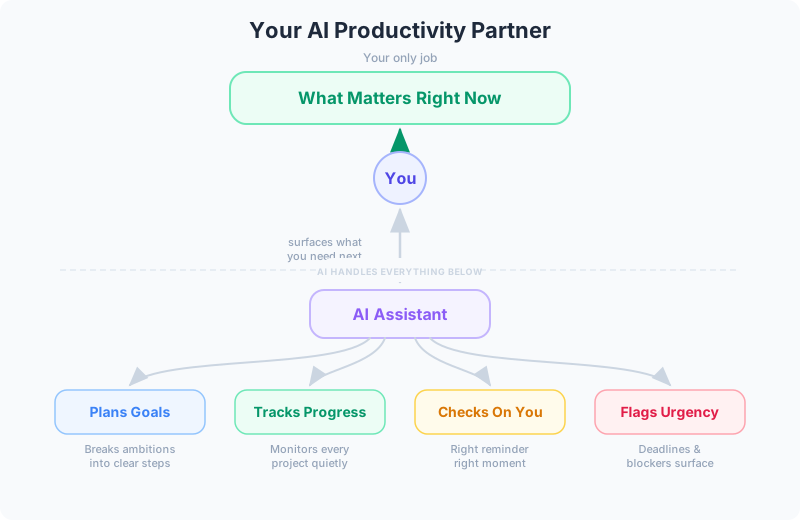
AI handles the maintenance tax. When you capture "I need to plan my sister's birthday party," an AI assistant can immediately propose: project created, three next actions defined (book venue, send invitations, order cake), context tags applied, due dates suggested. You review and approve in seconds instead of doing the clarification work yourself.
AI provides planning intelligence. Specialized AI experts can build structured plans for complex goals. Tell a fitness AI you want to run a marathon in 12 weeks, and it generates a complete training project with progressive milestones. Tell a nutrition AI you want to go keto, and it builds a meal plan. The domain expertise is embedded in the AI, so you don't need to be an expert to build an expert-level plan.
Structured accountability fills the loop. A daily review guided by AI takes 5 minutes instead of 30. The AI highlights stale projects, missed habits, and approaching deadlines. It asks the questions you should be asking yourself — but it asks them every day, whether you feel like reviewing or not.
The Consent Layer Traditional Systems Never Had
There's one more piece that modernizes productivity for 2026: the approval workflow.
In a traditional system, you're both the planner and the executor. You decide what goes on your list, and you decide what comes off. But in a world where AI can generate plans and other people can assign you tasks, you need a gatekeeper.
The approval workflow means nothing enters your trusted system without your explicit consent. AI generates a plan? It arrives as a proposal. A teammate assigns you a task? It appears in your inbox as a suggestion, not a commitment. You review, adjust, and approve — or reject.
This preserves the principle that your system should only contain things you've committed to, while letting AI and other people contribute planning intelligence without overwhelming you.
Building Your Modern System
If you're starting a productivity system or restarting after falling off, here's the modern approach:
-
Choose one capture tool. Not three apps. One inbox where everything goes. If it supports voice and text capture, even better.
-
Let AI clarify. Don't try to process every item manually. Let AI propose next actions, project groupings, and context tags. Your job is to review and approve, not to do the cognitive heavy lifting.
-
Do the daily review, not just the weekly. A 5-minute daily check-in (scan calendar, check habits, process inbox) is more sustainable than a 60-minute weekly marathon. The weekly review still matters, but the daily habit prevents the inbox from ever getting out of control.
-
Use the Minimum/Upgrade system for habits. Traditional productivity frameworks don't have a habit tracking component, but habits are a huge part of most people's lives. Set a Minimum (the smallest version you can do on your worst day) and an Upgrade (your ideal effort). Consistency beats intensity.
-
Delegate planning to experts. You don't need to know how to structure a marathon training plan or a nutrition program or a study schedule. That's what specialized AI and human experts are for. Your job is to define the goal and approve the plan.
-
Trust the system. This is the most important principle, and it hasn't changed. If you trust that every commitment is in the system, your mind is free. If you don't trust it, you're back to carrying everything in your head. The system only works if it's complete.
The Bottom Line
The core insight — get it out of your head, clarify it, organize it, review it, do it — is as relevant in 2026 as it ever was. What's changed is the tooling. AI can now handle the maintenance that used to make structured systems unsustainable for most people. The capture-clarify-organize loop can happen in seconds instead of minutes. And the weekly review that most people skipped can be replaced by a daily 5-minute ritual that's actually maintainable.
The result is the productivity system you always wanted: a mind like water, clear and responsive, free from the overhead of managing the system itself. That was always the promise. AI is what finally delivers it.