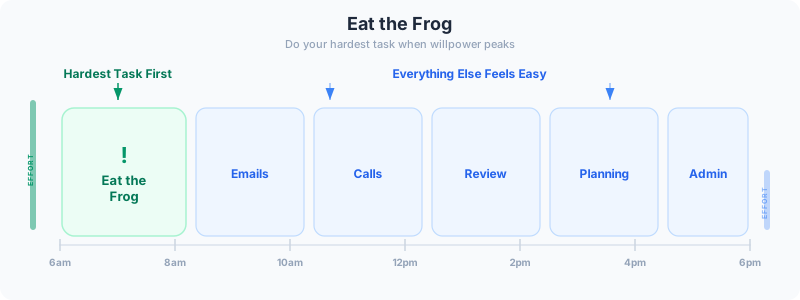
There's a task on your list right now that you've been avoiding. You know exactly which one it is. It's the one you skip over every time you glance at your to-do list, the one you tell yourself you'll "get to later," the one that fills you with a subtle dread every time you think about it.
That task is your frog. And according to Brian Tracy's influential productivity method, you should do it first thing in the morning.
88% of people procrastinate for at least 1 hour every day, averaging 55 lost days per year. 94% say procrastination makes them unhappy, yet they keep doing it because they start with easy tasks instead of the one that matters.
The Concept
The idea is simple and attributed (perhaps apocryphally) to Mark Twain: if the first thing you do each morning is eat a live frog, you'll have the satisfaction of knowing it's the worst thing you'll have to do all day.
Brian Tracy turned this into a full productivity philosophy in his book Eat That Frog! The core principle: identify the most important and most dreaded task on your list, and do it before anything else. Don't check email first. Don't organize your desk. Don't warm up with easy tasks. Go straight for the frog.
The Science Behind It
This isn't just motivational wisdom. There's solid research behind why tackling your hardest task first works.
Willpower depletion
The psychologist Roy Baumeister's research on ego depletion suggests that willpower behaves like a muscle: it fatigues with use. Every decision you make, every temptation you resist, every difficult conversation you have, they all draw from the same finite pool. By afternoon, that pool is depleted. The task that required moderate willpower at 8 AM requires heroic effort at 3 PM.
Decision fatigue
A famous study of Israeli judges found that prisoners were far more likely to receive parole early in the morning or right after a lunch break. As the day wore on and decision fatigue set in, judges defaulted to the easier choice: deny parole. Your brain does the same thing with tasks. As the day progresses, you default to the easier choice: skip the hard task.
Morning cortisol advantage
Cortisol, your body's alertness hormone, peaks naturally in the first few hours after waking. This is when your brain is sharpest, most creative, and most capable of handling complex, challenging work. Using this peak for email triage is like using a sports car to drive to the mailbox.
How to Identify Your Frog
Not every hard task is a frog. Not every task you're avoiding is a frog. The frog is specifically the task that sits at the intersection of three qualities:
1. It's important. Completing this task will move the needle on a meaningful goal or project. It's not just busy work that happens to be unpleasant.
2. You're dreading it. There's emotional resistance. Maybe it's a difficult conversation, a complex piece of writing, a decision with real stakes, or a task that forces you out of your comfort zone.
3. You keep putting it off. You've had multiple opportunities to do it and chose something else every time. It keeps rolling forward on your task list, day after day.
If a task checks all three boxes, that's your frog.
Quick identification exercise
Right now, look at your task list (or think about what's on your plate) and ask yourself: "If I could only finish one thing today, which task would make me feel the most relieved?" That's almost certainly your frog.
A Morning Routine Built Around the Frog
Here's a concrete morning workflow you can adopt starting tomorrow:
The night before: During your evening wind-down, identify tomorrow's frog. Write it down. Put it somewhere you'll see it in the morning. This is critical because you're making the decision when your willpower is low, so that morning-you doesn't have to.
6:00-7:00 AM (or whenever you wake): Normal morning routine. Coffee, breakfast, exercise, whatever grounds you. Don't look at email or messages yet.
First work block (whenever you sit down): Open your frog task immediately. Not email. Not Slack. Not the news. The frog. Set a timer for 25 minutes if you need a container (the Pomodoro Technique works beautifully here). Start.
After the frog: Now check email. Now respond to messages. Now handle the smaller stuff. You've already won the day. Everything else is a bonus.
Common Traps
Confusing urgent with important
Email marked "URGENT" is rarely your frog. A client request with a tight deadline might feel like a frog, but if it's straightforward work that just needs to get done, it's not. The frog is usually the task with no external deadline at all, the one nobody is asking about but that would transform your work or life if you completed it. Writing that book proposal. Having that performance conversation. Redesigning that broken process.
Picking too many frogs
You have one frog per day. Not three. If you have multiple dreaded tasks, pick the single most important one. The others can be tomorrow's frog or next week's. Trying to eat three frogs before lunch is a recipe for a miserable morning and abandoned effort.
Making the frog too big
"Redesign the company website" isn't a frog; it's a project. Your frog should be a single, concrete action you can complete (or make significant progress on) in one focused session. "Write the first draft of the homepage copy" is a frog. "Research three competitor websites for design inspiration" is a frog. Make it specific enough that you know when you're done.
Doing easy tasks to "warm up"
This is the most seductive trap. "I'll just knock out a few quick emails to build momentum." No. Those quick emails are stealing your best cognitive hours. The frog doesn't need a warm-up. It needs a start.
The Compound Effect of Eating Frogs
Here's what happens when you eat your frog every workday for a month: you complete roughly 20 tasks that you would have otherwise procrastinated on indefinitely. These aren't trivial tasks. These are the high-impact, needle-moving tasks that most people push off forever. After six months, the gap between you and someone who starts each day with email becomes enormous.
The financial impact is staggering: procrastination costs businesses approximately $15,000 per year for every $40,000 salaried worker. That's not laziness; it's a structural problem. And the frog method is the structural fix.
More importantly, you build a new identity: someone who does hard things. That identity spills into every area of your life.
How Actium Helps You Find Your Frog
The natural moment to identify your frog is during your daily review. As you scan your task list each morning, you're already looking at everything on your plate. Actium' AI planning can surface your highest-impact task based on your priorities and deadlines, essentially suggesting your frog before you even have to think about it.
The daily review becomes your "frog selection" ritual: review what's on your plate, pick the one task that matters most and that you're most likely to avoid, and commit to tackling it first.
Start Tomorrow Morning
Tonight before bed, write down one task you've been avoiding. Put the note next to your coffee maker or on your laptop keyboard. Tomorrow morning, before you do anything else, spend 25 focused minutes on that task.
That's all it takes to eat your first frog. In a world where 88% of people lose an hour a day to procrastination, the simple act of doing your hardest task first puts you in rare company. The relief of having it behind you before 10 AM isn't just satisfying; it's compounding.
Pair the frog method with the Pomodoro Technique for a powerful one-two punch. To understand how eating the frog fits into a full morning ritual, read The Power of a Daily Review. And for the broader philosophy of separating planning from doing, see Delegate the Planning, Approve the Plan.