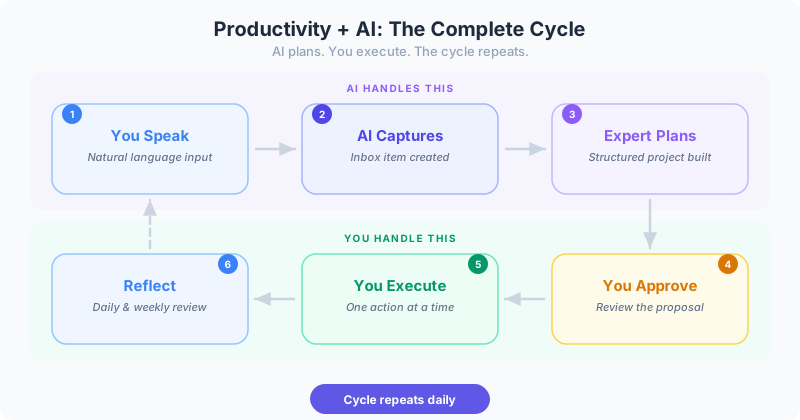
The promise of any good productivity system is simple: offload your thoughts into a trusted external system so you can focus on execution rather than remembering. It's a powerful idea, but achieving it has always been hard.
The reason? System Maintenance Fatigue.
Productivity apps have a Day 1 retention rate of just 17%, dropping to 4% by Day 30. The average employee is productive for only 2 hours and 53 minutes per day. The rest is spent on communication, coordination, and maintaining the very systems meant to save time.
Where Manual Systems Break Down
Every productivity system requires upkeep. You need to capture things, organize them, review them, and keep the whole machine running. In theory this takes 15-20 minutes a day. In practice, here's what actually happens:
1. The Inbox Pileup. You start capturing everything faithfully. Within a week, you have 40 items in your inbox. Processing them means deciding what each one is, what project it belongs to, and what the next action is. This is cognitively expensive work. So you postpone it. By week three, your inbox has 120 items and you can't face it. The system is already failing.
2. The Vague Project Problem. You write down "Plan family vacation" as a project. Great. But what's the next action? Research destinations? Check school holiday dates? Ask your partner what they want? The project sits there for weeks because breaking it into concrete steps requires real thinking, and you never seem to have the energy for it when you're doing your review.
3. The Stale Context List. You tag tasks with contexts like @Computer or @Phone, but the lists grow faster than you complete them. After a month, your @Computer list has 60 items and scrolling through it to find what's relevant right now takes longer than just doing the work from memory.
4. The Abandoned Weekly Review. The weekly review is supposed to be the cornerstone of your system. You do it faithfully for three weeks. Then you skip one weekend. Then another. Without the review, projects go stale, your inbox overflows further, and trust in the system collapses. You go back to keeping things in your head.
This cycle isn't a personal failure. It's a design problem: manual systems put the hardest cognitive work (planning, organizing, reviewing) on the person who's already busy. Workers spend 57% of their time communicating (email, chat, meetings) rather than doing actual work (Microsoft). When your productivity system adds more overhead to an already-overloaded day, it becomes part of the problem.
"Just Ask a Chatbot" Doesn't Work Either
You might think AI solves this. Ask ChatGPT to plan your vacation, organize your week, or design a workout routine. It'll give you something reasonable-sounding in seconds.
But 75% of customers say chatbots fail on complex issues (Chanl.ai analysis). The problem becomes obvious when you compare outputs. Take a common goal: "Help me train for a 10K run. I'm a beginner and I have 8 weeks."
What a generic chatbot gives you:
Start with a mix of walking and running. Gradually increase your distance each week. Make sure to include rest days. Stay hydrated and get proper running shoes. Consider cross-training. Listen to your body. Good luck!
That's not wrong, but it's not a plan. It's a wall of generic advice that leaves you asking: "Okay, but what do I actually do on Monday?"
What a specialized fitness expert gives you:
8-Week 10K Training Plan (Beginner, 3 runs/week + 1 cross-train)
Weeks 1-2: Build the habit
- Mon: Run/walk 20 min (run 2 min, walk 1 min, repeat)
- Wed: Run/walk 20 min
- Fri: Cross-train 30 min (bike, swim, or brisk walk)
- Sun: Run/walk 25 min
Weeks 3-4: Increase run intervals
- Mon: Run/walk 25 min (run 4 min, walk 1 min)
- Wed: Run/walk 25 min
- Fri: Cross-train 30 min
- Sun: Run 30 min continuous (slow pace)
24 tasks created, organized by week. Approve this plan?
One gives you information. The other gives you a system you can execute.
A personalized, domain-specific approach doesn't just feel better; it performs better. H&M's personalized chatbot styling advice achieved a 70% engagement rate, compared to single-digit engagement with generic recommendations. The same principle applies to productivity: a plan built for your schedule, constraints, and experience level is dramatically more likely to be followed.
Why Specialization Matters
A fitness expert, whether human or AI, brings domain knowledge that a generalist doesn't have:
- Progressive overload. You don't jump from 2-mile run/walks to a 10K in week three. The expert structures a gradual build-up.
- Recovery cycles. Rest days and easier weeks are placed deliberately, not as an afterthought.
- Practical structure. Tasks are scheduled on specific days with specific durations, not offered as general principles.
The same applies to every domain. A nutrition expert understands meal prep logistics. A career coach knows that "update your resume" is really five separate tasks. A financial planner knows the correct order for paying down debt.
Specialization isn't just about knowing more. It's about knowing what matters in a specific domain and structuring advice into steps you can actually follow.
A Worked Example: Plan a Family Vacation
To see how quickly complexity explodes, consider a single goal: "Plan a family vacation to Portugal in August."
A proper breakdown might look like this:
- Check school holiday dates and confirm travel window
- Discuss budget with partner and agree on a range
- Research 3-4 regions in Portugal (Algarve, Lisbon coast, Porto, Azores)
- Shortlist accommodation options and compare prices
- Book flights (check if kids need passport renewals first)
- Check passport expiry dates for all family members
- Renew any passports that expire within 6 months of travel
- Book accommodation and confirm cancellation policy
- Research car rental options and book if needed
- Plan a rough day-by-day itinerary
- Buy travel insurance
- Make a packing list
That's 12 tasks for a single, fairly ordinary goal. Some have dependencies. Some have deadlines. Some require input from other people. And this is just one project among the 15-30 active projects most adults juggle at any given time.
Manually building this plan takes real effort. A specialized AI expert builds it in seconds and submits it for your review before a single task touches your list.
How to Get Better Results from Any AI
Whether you're using a specialized expert or a general chatbot, these habits dramatically improve the output:
1. Be specific about your goal. "Help me get fit" is vague. "Help me train for a 10K in 8 weeks, I currently run 2 miles twice a week" gives the AI enough to build a real plan.
2. Provide your constraints. Time, budget, equipment, schedule, experience level. The more constraints you share, the more realistic the plan.
3. Ask for structured output. Instead of "give me advice," say "give me a week-by-week plan with specific tasks." This forces the AI out of essay mode and into planning mode.
4. Request a checklist, not a narrative. "Give me this as a numbered task list I can check off" produces dramatically more actionable output.
Where AI Changes the Equation
The tedious parts of system maintenance, including breaking goals into tasks, identifying dependencies, and structuring a project plan, are exactly what AI is good at. This is the core idea behind Actium: you state a goal, and a specialized AI expert builds the full project breakdown for you. You review the plan, approve what makes sense, and focus your energy on execution rather than planning.
The result is a system where the hardest cognitive work is handled for you, so you can maintain the habits that keep everything running. When 96% of app users disappear within a month, the only systems that survive are the ones that make maintenance effortless.
The gap between generic advice and a real plan is the gap between knowing what to do and actually doing it. Specialized AI closes that gap.
Read about how planning and approval work together to keep AI plans under your control while you focus on execution.