There's a reason elite athletes have coaches, CEOs have executive assistants, and film directors have producers. Planning and executing are fundamentally different kinds of work, and trying to do both at the same time is a recipe for mediocrity at each.
Planning requires stepping back, thinking strategically, considering dependencies, and mapping out a path from here to there. Executing requires focus, momentum, and the confidence to act without second-guessing every step.
When you try to do both, you get stuck in a painful loop: start a task, realize you're not sure what comes next, stop to plan, lose momentum, get overwhelmed by the planning, abandon the project entirely.
82% of people don't have any time management system in place. Yet spending just 10-12 minutes planning your day saves roughly 2 hours of wasted effort, a 25% productivity gain. The problem isn't that planning doesn't work. It's that most people try to plan and execute simultaneously, and fail at both.
Separate the Planner from the Executor
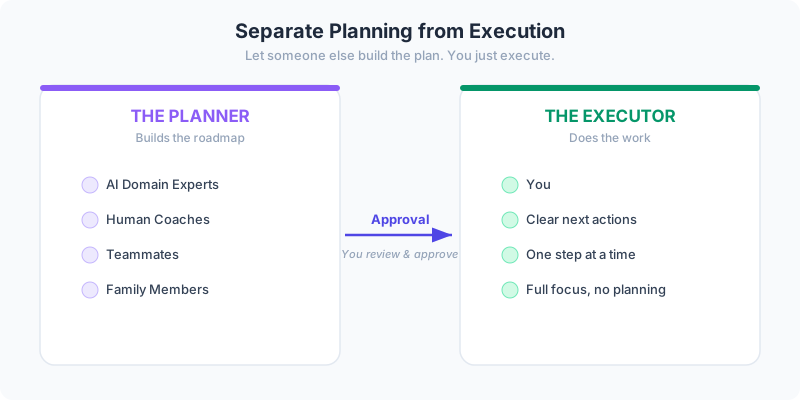
Actium is built on a simple principle: separate the person who plans from the person who executes.
In practice, this means you don't sit down with a blank project and try to figure out all the steps yourself. Instead, you tell a Planner (an AI expert, a coach, a teammate) what you want to achieve. They build the plan. You review and approve it. Then you execute, one clear step at a time.
Planning is cognitively expensive. Breaking a goal like "launch a side project" into actionable steps requires you to hold the entire project in your head, think through dependencies, estimate effort, and sequence everything correctly. It's draining, and it's the reason most side projects never get past the planning phase.
Executing is energizing. When someone hands you a clear list of next actions ("Set up the repository," "Write the landing page copy," "Send the beta invite email"), you can enter a flow state and make real progress. Each completed task gives you momentum for the next one.
The Science Behind Separation
Cal Newport calls this the problem of "attention residue." When you switch from planning mode to execution mode, a residue of the planning mindset lingers, fragmenting your focus on the actual work. Research by Sophie Leroy at the University of Minnesota found that people perform significantly worse on a task when they've just been thinking about a different one. Adults make roughly 35,000 decisions per day, and decision fatigue causes increasingly impulsive or passive choices as the day wears on. Every planning decision you make during execution is one more drain on the finite pool of focus you need for the work itself.
The Planner/Executor model eliminates this switch entirely. You never have to context-switch between "what should I do?" and "let me do it." The planning happens before your work session. When you sit down to execute, the only thing in front of you is the next action.
But Here's the Problem: Who Controls the Plan?
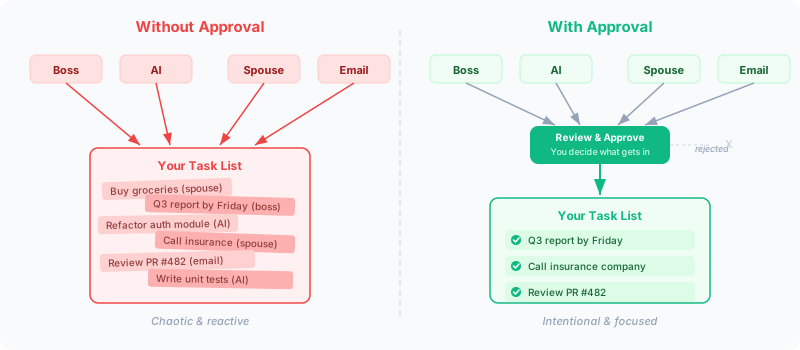
Separating planning from execution creates a new risk: someone else now decides what's on your plate. Your AI generates fifteen tasks from a single prompt. Your manager drops a message: "Can you handle this by Friday?" Your partner says: "Don't forget to call the insurance company."
Suddenly your carefully curated to-do list is a chaotic dumping ground for everyone else's priorities.
Workers are interrupted once every 2 minutes, roughly 275 times per day. Each interruption costs an average of 23 minutes to fully recover focus (UC Irvine). Over a year, context switching alone wastes the equivalent of 5 full working weeks.
Your task list should be sacred. It represents your commitments, the things you've consciously decided to spend your finite time and energy on. When anyone can add to it without your consent, you lose control of your own day.
The Solution: Nothing Enters Without Your Approval
Actium introduces a simple but powerful concept: nothing enters your active system without your explicit approval.
When someone, whether it's an AI expert, a teammate, or a family member, wants to assign you work or suggest a plan, it doesn't land directly in your task list. Instead, it arrives as a Plan Proposal: a clean summary of what's being suggested, who suggested it, and what it would look like in your system.
You review it. You either approve it (and the tasks flow into your active workflow) or you reject it (and nothing changes). That's it.
Why This Changes Everything
1. You stay in control. No more surprise tasks cluttering your carefully organized day. Every item in your system is something you've consciously accepted.
2. AI becomes useful, not overwhelming. AI is incredible at planning. It can break a complex goal into dozens of structured steps in seconds. But without an approval layer, that power becomes a firehose of tasks you never asked for. The approval workflow turns AI from a firehose into a tap you control.
3. Collaboration improves. When your teammate proposes a plan rather than assigning tasks directly, it creates a moment of dialogue. You can negotiate scope, adjust timelines, or suggest alternatives before the work hits your plate.
4. Your mental health benefits. There's a real psychological cost to feeling like your task list is out of your control. Research shows employees lose up to 40% of their productivity when switching between tasks that were externally imposed rather than self-directed. The approval workflow gives you back the sense of agency that most productivity tools quietly take away.
This Isn't New: It's How High Performance Already Works
- Athletes and coaches. LeBron James doesn't design his own training program. His coaches study film, plan periodization, and structure recovery. LeBron focuses entirely on execution. But LeBron still decides which team to play for and what goals to pursue.
- Surgeons and surgical planners. The surgeon doesn't spend the morning scheduling the operating room. A team handles the logistics so the surgeon can focus on the procedure. But the surgeon reviews the surgical plan before operating.
- Software engineers and product managers. Product managers own the roadmap. Engineers own the code. But engineers review and push back on requirements that don't make sense.
In each case, the person executing does their best work precisely because someone else has done the planning, and the executor had a say in what was planned.
Consent-Based Productivity
We talk a lot about consent in other areas of life, but rarely in how we manage work. The approval workflow is consent-based productivity: the principle that you should have a say in what you commit to, every single time.
Think of it like hiring an architect to design your house. They bring the expertise and the blueprint. You approve the design, request changes, and ultimately decide what gets built. But you don't have to learn architecture yourself.
Start Delegating, Start Approving
The next time you have a big goal, whether it's training for a race, organizing a move, or launching a project, resist the urge to sit down and plan it yourself. Describe the outcome you want and let someone (or something) else figure out the steps. Then review the plan before committing to it.
In a world where the average worker faces 275 interruptions a day and 82% of people run their days without any system at all, the combination of delegated planning and explicit approval isn't just a productivity technique. It's a survival skill.
Your system. Your rules. Your approval.
For how AI experts build these plans differently from generic chatbots, read Why Your Productivity System Needs AI. For protecting your focus once you have a clear plan, see Deep Work in Practice.