In 1987, a struggling university student named Francesco Cirillo picked up a tomato-shaped kitchen timer, set it for 25 minutes, and made himself a deal: he would focus on nothing but his studies until the timer rang. No distractions. No multitasking. Just 25 minutes of undivided attention.
It worked. That simple experiment became the Pomodoro Technique, one of the most widely used focus methods in the world. Nearly four decades later, it still works, because the problem it solves hasn't changed: our brains aren't built for hours of unbroken concentration, but they're very good at sprinting.
59% of workers can't focus for even 30 minutes without getting distracted. Workers check email up to 36 times per hour and take 16 minutes to refocus after each check. The Pomodoro Technique exists because our environment is designed to break our focus.
How the Pomodoro Technique Works
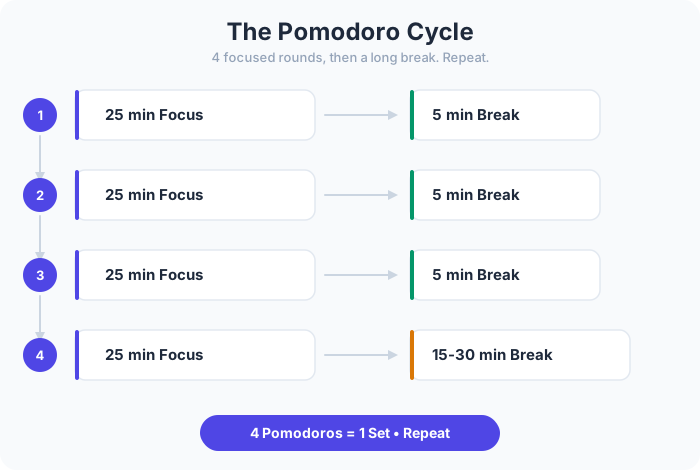
The full method has five steps:
- Choose a task. Pick one thing you want to work on. Not three things. One.
- Set a timer for 25 minutes. This is one "pomodoro." During this time, you work on nothing but the chosen task.
- Work until the timer rings. If a distraction pops into your head, write it down on a piece of paper and return to the task. Do not check email. Do not reply to messages. Do not "quickly" look something up.
- Take a 5-minute break. Stand up. Stretch. Get water. Look out the window. The break is not optional.
- After four pomodoros, take a longer break (15-30 minutes). This is your recovery period. Walk around the block. Eat a snack. Let your brain fully reset.
That's it. 25 on, 5 off, repeat four times, then take a real break. The magic is in the constraint.
How to Do Your First Pomodoro Today
You don't need an app, a course, or special equipment. Here's your step-by-step for right now:
Step 1: Look at your task list and pick the one item you've been avoiding the most. That's your pomodoro task.
Step 2: Put your phone face-down in another room. Close every browser tab that isn't related to your task. If you work in an open office, put on headphones (even without music, they signal "don't interrupt me").
Step 3: Set any timer for 25 minutes. Your phone's built-in timer, a kitchen timer, a browser tab. It doesn't matter.
Step 4: Work. When your brain says "I should check Slack," don't. Write "check Slack" on a sticky note and keep going. When it says "I wonder if that email came in," don't. Write it down. Keep going.
Step 5: When the timer rings, stop. Even if you're in the middle of something. Especially if you're in the middle of something. (Stopping mid-flow makes it easier to pick up where you left off, a trick called the Zeigarnik effect.)
Step 6: Stand up and take 5 minutes completely away from your screen.
You just completed your first pomodoro. Notice how it felt. Most people are surprised by two things: how hard it was to resist distractions, and how much they accomplished in 25 minutes.
Common Mistakes (and How to Avoid Them)
Making pomodoros too long
Some people think "if 25 minutes is good, 50 must be better." It's not. The 25-minute window works because it's short enough that your brain doesn't resist starting. Extending it introduces the same dread that makes you procrastinate on big tasks. If 25 feels too short once you're in flow, finish the pomodoro, take your break, and start another one. The breaks are part of the system.
Skipping breaks
This is the most common mistake. You're in the zone, the timer rings, and you think "I'll just keep going." Don't. The breaks serve a neurological purpose: they allow your brain's diffuse mode to process what you just worked on. Some of your best ideas will come during those 5 minutes of rest. Skipping breaks leads to diminishing returns and eventual burnout.
Using pomodoros for easy tasks
Pomodoros are a focus tool. You don't need deep focus to reply to a routine email or update a spreadsheet. Save your pomodoros for work that requires real cognitive effort: writing, coding, designing, analyzing, strategizing. Use batch processing for the easy stuff.
Treating interruptions as failures
If someone taps your shoulder during a pomodoro, that's not a failure. Note where you are, handle the interruption if it's truly urgent, and either resume or restart the pomodoro. The technique is a tool, not a religion. Real life has interruptions.
What Tracking Your Pomodoros Tells You
One of the most powerful (and overlooked) parts of the technique is tracking how many pomodoros you complete each day. Over a week or two, patterns emerge:
- Capacity awareness. Most knowledge workers can sustain 8-12 pomodoros per day. That's 3.3 to 5 hours of genuinely focused work. If that sounds low, it is, and it's also realistic. The rest of your day is meetings, email, conversations, and maintenance. Studies confirm this: the average employee is productive for only 2 hours and 53 minutes per day. Pomodoro tracking reveals your real capacity, which is almost always less than you think.
- Task estimation. After tracking for a while, you'll get good at estimating how many pomodoros a task will take. "Write the proposal" becomes "write the proposal (3 pomodoros)." This is dramatically more useful for planning than vague time estimates.
- Trend spotting. If your pomodoro count drops on Wednesdays, maybe that's your heavy meeting day and you should stop scheduling deep work then. If it spikes on mornings, maybe you should protect your mornings more aggressively.
Making Pomodoros a Daily Habit
The technique works best when it becomes a habit rather than something you remember to do occasionally. The key is setting a realistic daily target and tracking it.
A good starting point: aim for a minimum of 2 pomodoros per day. That's less than an hour of focused work, achievable even on your busiest days. On good days, stretch for 6 or more. The minimum keeps the habit alive; the stretch goal lets you capitalize on high-energy days.
In Actium, you can set this up as a habit with the Min/Upgrade system: set your minimum at 2 pomodoros and your upgrade at 6. Log your count during your daily review, and watch the consistency compound over weeks. The data becomes a feedback loop, showing you exactly how much focused work you're actually doing versus how much you think you're doing.
Start With One Pomodoro
You don't need to overhaul your workday. You don't need to commit to eight pomodoros tomorrow. Start with one. Today. Right now, if you can. Pick a task, set a timer, and give it 25 minutes of your full attention.
You might be surprised how much you can do when you stop trying to do everything at once. In a study comparing Pomodoro users to self-regulated workers, the Pomodoro group scored higher focus and 82% vs 70% performance, while studying for 25% less time. Focus beats hours, every time.
For a deeper look at protecting your focus time, read Deep Work in Practice. If you want to turn the pomodoro count into a lasting habit, see The Minimum/Upgrade Habit System. And for a daily ritual that helps you choose what to focus on, check out The Power of a Daily Review.